B Plus Tree Index
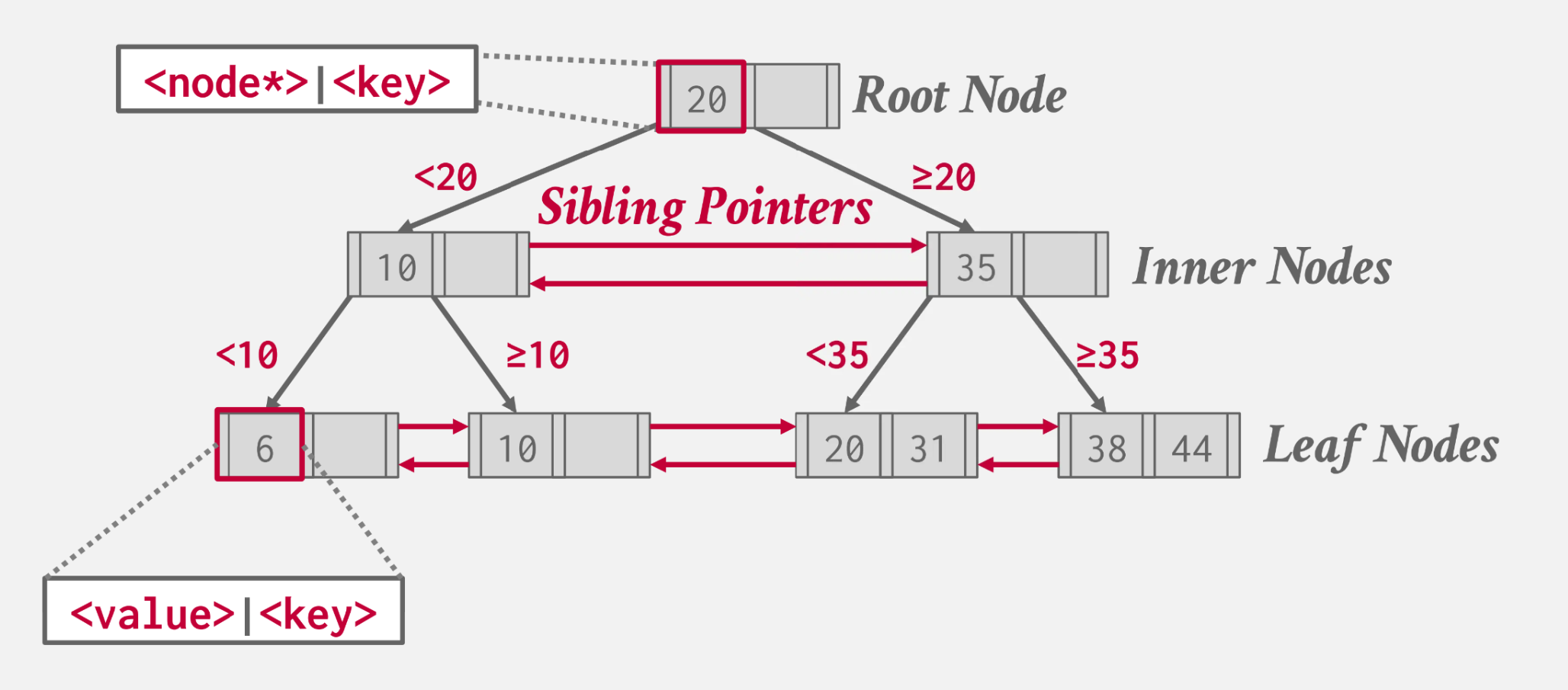
B+ Tree
- Self-balancing
- Ordered
- searches, sequential access, insertion and deletion in O(log n)
Properties
- Perfectly balanced (every leaf node is at the same depth in the tree)
- Every non-root node has key count of
(M / 2 - 1) <= #keys <= (M - 1) - Every inner node with k keys has k + 1 non-null children
B Tree VS. B+ Tree
B 树在树的任意节点存储键值对,而 B+ 树只在叶子节点存储值。
B+ 树具有更好的并发访问性能和顺序 I/O 性能
Basic Operations
B+ 树操作可视化,仅供参考 B+ Trees
Insert
通过大小关系找到目标叶子节点 L,插入 entry
如果插入节点后的元素数小于 M,结束
如果插入节点后的元素数等于 M,分割节点,将 key 提升到父节点
Delete
通过大小关系找到目标叶子节点 L,删除 entry
如果删除节点后的元素数量大于 M / 2 - 1,结束
如果删除节点后的元素数量等于 M / 2 - 1,则进行重新分配,从相邻的兄弟叶子节点分配 entry。
如果重新分配失败,即节点和兄弟节点在删除节点后元素数都小于等于 M / 2 - 1,则合并两个叶子节点
Selection Conditions
Duplicate Keys
对于插入以及存在的 key,有两种方法:
- 和插入不同的 key 一样直接插入
- 添加 overflow 节点,将 key 插入 overflow 节点
Clustered Indexes
将表按照主键的顺序存储在硬盘上
Index Scan Page Sorting
找到查询需要的所有 tuple,基于其 page ID 进行排序
B+ Tree Design Choices
Node Size
The slower the storage device, the larger the optimal node size for a B+Tree.
- HDD: ~1MB
- SSD: ~10KB
- In-Memory: ~512B
Merge Threshold
使用一个节点合并阈值以延迟合并操作
Delaying a merge operation may reduce the amount of reorganization.
It may also be better to just let smaller nodes exist and then periodically rebuild entire tree.
Variable-Length Keys
- Pointers
- 在节点中存储指向 key 实际数据的指针
- 会导致产生非连续 IO (nonsequential IO)
- Variable-Length Nodes
- 每个节点的长度可变
- 需要谨慎的内存管理
- Padding
- 总是将键拓展到键类型的最大长度
- Key Map / Indirection
- 将键值对另外存储,在 B 树中只存储键值对的指针
Intra-Node Search
- Linear: 直接进行线性查找
- 使用 SIMD 进行批量比较
- Binary: 进行二分查找
- Interpolation
Optimizations
Prefix Compression,,
| robbed | robbing | robot |
|---|
Prefix: rob#
| bed | bing | ot |
|---|
Deduplication
| K1 | V1 | K1 | V2 | K1 | V3 | K2 | V4 |
|---|
| K1 | V1 | V2 | V3 | K2 | V4 |
|---|
Suffix Truncation
有时不需要存储完整的键,可以将其截断进行存储
Pointer Swizzling
一般在访问某个特定 page 时,会使用逻辑指针 pageid 在对应 table 中查询进行访问,对于已经被固定在内存中的 page 可以直接通过物理指针进行访问以减少内存 I/O,提升访问性能。
Bulk Insert
通过先排序键再从下到上建立索引,快速为现有的表构建新的 B+ 树
在一些时候,对 B+ 树的插入和删除操作会造成很大的开销。
Write-Optimized B+ Tree Bε-trees
当进行写入时,不立即应用更新,而是将操作存储到 inner nodes 的日志缓冲区(或 mod,, log)
当缓冲区已满时,将日志中的条目按照更新的键传递到子节点;若无子节点,则应用更新。